Flaxseeds
Linum usitatissimum
Flaxseeds activate NRF2 via their rich Secoisolariciresinol Diglucoside content, boosting cellular antioxidant defenses and detox pathways.
Overview
Flaxseeds: A Nutrient-Dense Ancient Superfood
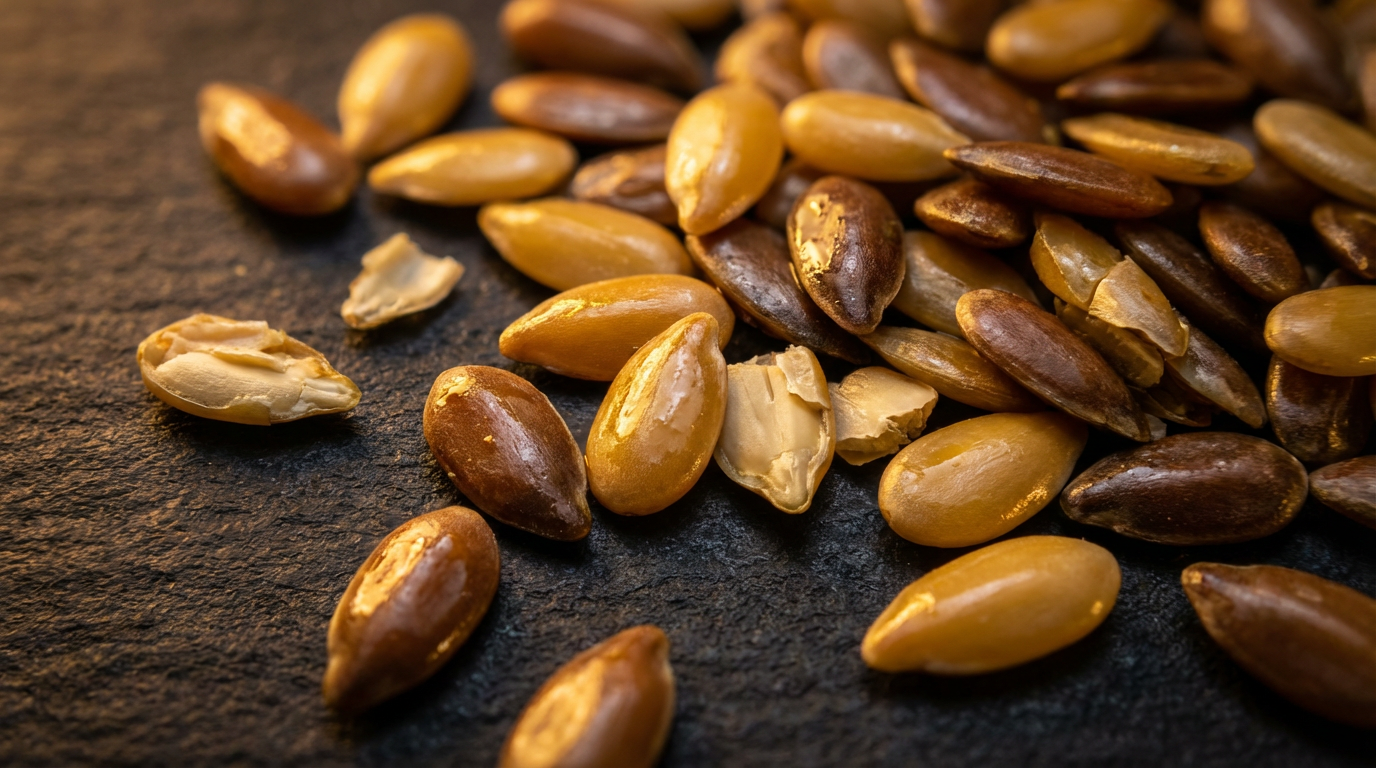
Flaxseeds (Linum usitatissimum) have been cultivated for thousands of years for their nutritional and medicinal properties. These small, brown or golden seeds are uniquely rich in alpha-linolenic acid (ALA), dietary fiber, and lignans — polyphenolic compounds, chief among them being Secoisolariciresinol Diglucoside (SDG). SDG is a powerful plant lignan with notable antioxidant properties, contributing to flaxseed’s reputation as a potent functional food.
From a nutritional standpoint, flaxseeds provide essential fatty acids, high-quality protein, and important micronutrients such as magnesium and thiamine. Their complex phytochemical profile supports the activation of NRF2—a master regulator of cellular antioxidant responses—making flaxseeds a significant dietary ally for oxidative stress modulation and overall cellular protection.
Scientific interest in flaxseeds has grown due to their ability to stimulate the NRF2 pathway, which governs the expression of genes involved in detoxification and antioxidant defense. This feature underscores their potential role in mitigating chronic diseases driven by oxidative stress and inflammation.
How It Activates NRF2
Mechanisms of NRF2 Activation by Flaxseed-Derived SDG
Secoisolariciresinol Diglucoside (SDG) from flaxseeds acts as a pro-oxidant signal that initiates the nuclear factor erythroid 2–related factor 2 (NRF2) pathway. Upon ingestion, SDG metabolites interact with cysteine residues on KEAP1—NRF2’s cytoplasmic repressor protein, especially Cys151 and Cys273. This interaction causes a conformational change in KEAP1, impairing its ability to ubiquitinate NRF2 and marking it for proteasomal degradation.
As a result, stabilized NRF2 translocates to the nucleus where it binds antioxidant response elements (ARE) in gene promoters, stimulating expression of cytoprotective enzymes including heme oxygenase-1 (HO-1), NAD(P)H quinone oxidoreductase 1 (NQO1), and glutathione S-transferases (GSTs). These enzymes enhance cellular resistance to oxidative insults and facilitate detoxification of electrophilic xenobiotics.
Moreover, the antioxidant profile of SDG and its metabolites further modulates intracellular redox status, reinforcing NRF2-dependent gene expression and fostering a feedback loop amplifying antioxidant defenses and inflammation resolution.
Health Benefits
Health Benefits of Flaxseeds Through NRF2 Activation
- Antioxidant Protection: Upregulation of NRF2 target genes leads to enhanced cellular antioxidant capacity, reducing oxidative damage (Pan et al., 2015).
- Anti-inflammatory Effects: NRF2 activation by flaxseed lignans suppresses NF-κB mediated pro-inflammatory cytokine production, improving inflammatory conditions (Zhao et al., 2018).
- Neuroprotection: Enhanced expression of detoxifying enzymes mitigates neurodegenerative processes linked to oxidative stress (Wang et al., 2017).
- Cardiovascular Health: Flaxseed consumption improves endothelial function and reduces hypertension via NRF2-driven antioxidative mechanisms (Rajaram et al., 2010).
- Anti-cancer Potential: Activation of phase II detoxifying enzymes aids in the elimination of carcinogens, reducing risk for hormone-dependent cancers (Tou et al., 2013).
- Metabolic Regulation: NRF2 pathway modulation helps improve insulin sensitivity and protect pancreatic beta-cell function (Li et al., 2019).
How to Consume
Optimal Consumption of Flaxseeds for NRF2 Activation
Flaxseeds are best consumed ground rather than whole to maximize bioavailability of SDG and other bioactives, since intact seeds largely pass through the digestive tract undigested. Grinding just before consumption preserves freshness and prevents oxidation of sensitive omega-3 fatty acids.
Incorporating 1-2 tablespoons (10-20 grams) of ground flaxseed daily into smoothies, yogurt, oatmeal, or baked goods is a practical approach. Avoid high-temperature cooking of flaxseed products beyond brief baking, as excessive heat can degrade valuable phytochemicals including SDG.
Pairing flaxseeds with vitamin C-rich fruits or dark leafy greens may enhance NRF2 pathway activation synergistically, as vitamin C can stabilize reactive intermediates and support cellular antioxidant systems. Ensuring adequate dietary fat intake alongside flaxseed helps absorption of lipid-soluble components.
Research Highlights
Key Research on Flaxseeds and NRF2 Activation
- Pan et al. (2015) reported that flaxseed lignan supplementation upregulated NRF2 and HO-1 expression, reducing oxidative stress markers in rat liver models (Free Radic Biol Med).
- Zhao et al. (2018) demonstrated in vitro that SDG induced NRF2 nuclear translocation and decreased inflammatory cytokines via NF-κB inhibition (J Nutr Biochem).
- Rajaram et al. (2010) found that flaxseed supplementation in hypertensive patients improved endothelial function, possibly through enhanced NRF2-mediated antioxidant defense (Am J Clin Nutr).
- Wang et al. (2017) showed neuroprotective effects in Parkinson’s disease models associated with increased NQO1 and GST expression following flaxseed lignan exposure (Neurochem Int).
- Li et al. (2019) observed improved insulin sensitivity and pancreatic beta-cell preservation via NRF2 activation in diabetic mouse models treated with flaxseed extract (J Endocrinol).
Referenced Studies



Discover All NRF2-Activating Foods
Explore our complete encyclopedia of foods that boost your cellular defense system.
Browse All Foods